


Native Wild Types vs Native Cultivars
What's the Difference?
There are a lot of terms that are used in the landscaping industry and plant biology academia, and it's hard to know what all of them mean. Cultivar, variety, subspecies? What difference does it make to your garden, or to the ecosystem around us? Let's talk about it.
Wild Type or Native Species
The term "wild type" refers to the original form of the species that you would find in the wild. For example, the Redbud Tree (Cercis canadensis) is a wild type. It's a form that occurs in nature and produces seeds that will grow into the same form as itself. Sometimes people will simply refer to these plants as "native species."

Variety and Subspecies
Sometimes varieties of species will occur naturally in the wild. A common example is the White Redbud Tree (Cercis canadensis var. alba). We as humans didn't breed this tree to be white, it just happened on its own. Its seeds will grow into Redbuds that are, most of the time, white-flowering. These populations of white-flowering redbuds exist side by side in the same range as the more traditional red/pink-flowering redbuds.
The terms "variety" and "subspecies" are sometimes used interchangeably, but there are slight differences between the two terms that are still often debated within the scientific community. For the average gardener, they both refer to naturally occurring variations within a species.
If you want to get more specific, generally "variety" refers to a variation within a species that lives in the same range alongside the usual wild type population. "Subspecies" usually refers to a variation within a species that is somewhat geographically isolated from other populations. There can be any number of subspecies or varieties within a species. The researchers of each plant make these determinations, and these can change as our understanding of each species progresses over the years. Usually, the most recently published research with good evidence is the one that is recognized.

Eco-Type
"Eco-type" is another term that refers to a population that has notable differences from the rest of its species. It refers to a group that can be defined as needed by the person describing it. It isn't part of a plant's taxonomy.

For example, maybe a researcher wants to note the differences between Lanceleaf Coreopsis populations in Fort Worth versus in Dallas. This person is defining two eco-types based on region for their own purposes of their specific research. Someone else may be comparing Lanceleaf Coreopsis populations in the DFW area to ones in East Texas. This second researcher is also defining two eco-types based on region, but these areas are different from the first researcher and are entirely dependent on the second researcher's area of study. Eco-type is subjective and depends on the researcher defining their areas of study.
Cultivar
"Cultivar" refers to a plant that has been intentionally modified by humans to select for traits we deem desirable. Usually the traits bred for are things like longer bloom time, disease and pest resistance, increased frost or drought hardiness, or things related to aesthetics like color or shape.
Creating a cultivar can be done in a handful of ways: encouraging the growth and reproduction of a naturally occurring mutation, or hybridizing two plants to create a new plant through human-controlled cross-pollination, the propagation of cuttings, or grafting two plants together. Sometimes you may see the word "nativar," and that simply means a cultivated native plant as opposed to a cultivated non-native plant.

Do Pollinators Care?
The short answer is - it depends, but native wild types are a better bet. For a few native plants, preliminary research found that native bees visited wild types almost three times more frequently than they visited cultivars (Hayes and Langelloto, 2022). Research is only just beginning to be conducted on questions like these, and each cultivar is different. Native wild types evolved as a part of their ecosystem, so they are uniquely suited to their soil and climate, and to pollinators and other animals in their ecosystem. Changing a wild type is a toss up in terms of how their new traits will affect the other living organisms around them.

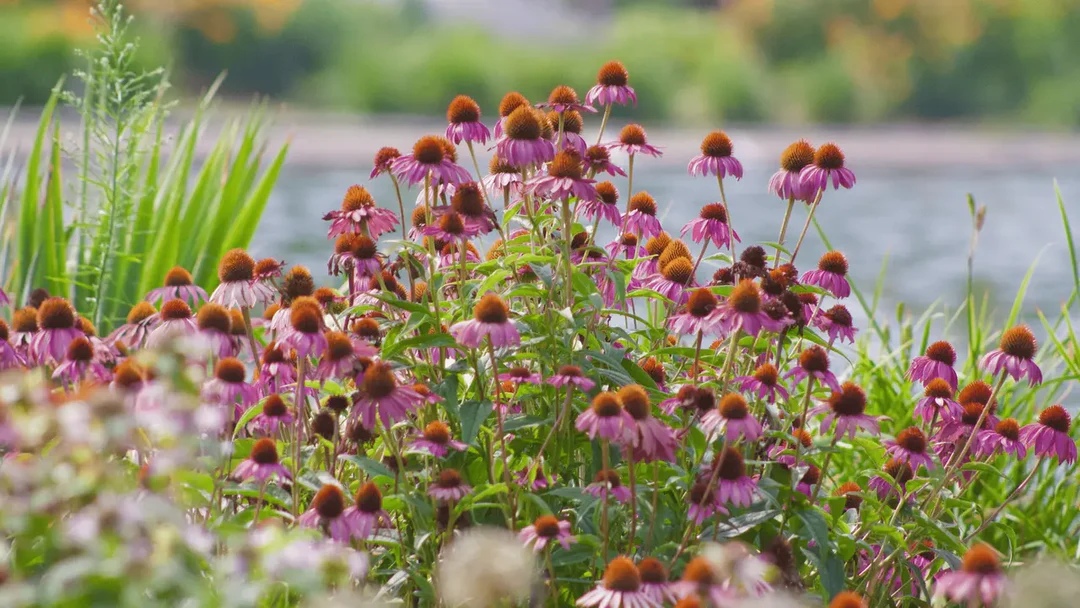
Sometimes, the color of the cultivar matters. Pollinators' vision is different from ours, and flowers have evolved to look like attractive, easily visible targets for the birds and insects that visit them. Bees, for example, can see ultraviolet light that we can't, but they can't see the reds, oranges or yellows that we can. Purple Coneflower (Echinacea purpurea) is a wild type that attracts numerous pollinators. While Purple Coneflowers are highly visible to bees, a cultivar , Green Jewel Coneflower (Echinacea purpurea 'Green Jewel'), is much less appreciated by bees simply because they can't see it as well.
Other times, a more complex shape that we might deem beautiful makes a plant almost useless to pollinators. Pink Double Delight Coneflower (Echinacea purpurea 'Pink Double Delight') is a cultivar that features showy, double-centered flowers. Despite its beauty, it attracts no pollinators. Why? Firstly, the complicated structure makes its nectar very difficult or impossible for pollinators to access. Secondly, this particular cultivar is sterile, meaning it produces very limited amounts of nectar, and it doesn't produce viable seeds, or any pollen.

Other times, pollinators might find a cultivar very attractive. A cultivar of Great Camas (Camassia leichtlinii) 'Sacajawea' received more visits from bees because its blooms lasted longer, so the bees had more time to visit. There are unlimited amounts of variables that could change with each cultivar that we create, and each change might affect pollinator's ability to successfully visit these plants.
Spreading
When it comes to reproducing themselves, each cultivar is different. Some cultivars are sterile and can only be reproduced by human methods. Some cultivars do produce seeds, but they don't grow into the cultivar - they grow into the original wild type. Some cultivars produce seeds that will in fact grow into that same cultivar.
This can be good or bad news depending on your goals. Some landscapers would prefer that the fertile seeds grow into the cultivar so they can have more of their intended plant in the garden. However, for ecologists, it can be a concern if those cultivar seeds spread and produce cultivar plants in the wild. If wild plants are then fertilized by that cultivar's pollen, it can affect the genetics of the population in that area, leading to plants that might be an issue for pollinators because of the reasons discussed previously.
So, What Should I Plant?
That, as always, is up to you! If your goal is to attract more pollinators, or to be more true to your area's ecosystem, wild types will usually be your best choice. If you want to mix it up with cultivars to achieve a different look, you can do that too.
We recommend planting mostly wild type native plants, but allowing yourself a few nativars if they bring you joy. Your garden is for the pollinators, and you too! There is no single right answer - only more opportunity for learning.
Research on the pollinator value of each specific nativar is often limited. So, ask a gardening friend or a Native Gardeners team member what they have personally observed. For example, at the nursery we notice less insects visiting cultivars of Echinacea purpurea than the wild type. But with Salvia greggii, the native colors and cultivar colors seem to be equally popular among pollinators.
Sources and Further Reading:
https://yardandgarden.extension.iastate.edu/faq/what-difference-between-cultivar-and-variety
https://xerces.org/blog/cultivar-conundrum
https://pollinatorgardens.org/2013/02/08/my-research/
https://www.wildflower.org/expert/show.php?id=11198
https://pmc.ncbi.nlm.nih.gov/articles/PMC7521339/
https://pdxscholar.library.pdx.edu/uerc/2022/Posters/2/
https://pdxscholar.library.pdx.edu/cgi/viewcontent.cgi?article=1237&context=uerc


Leave a comment